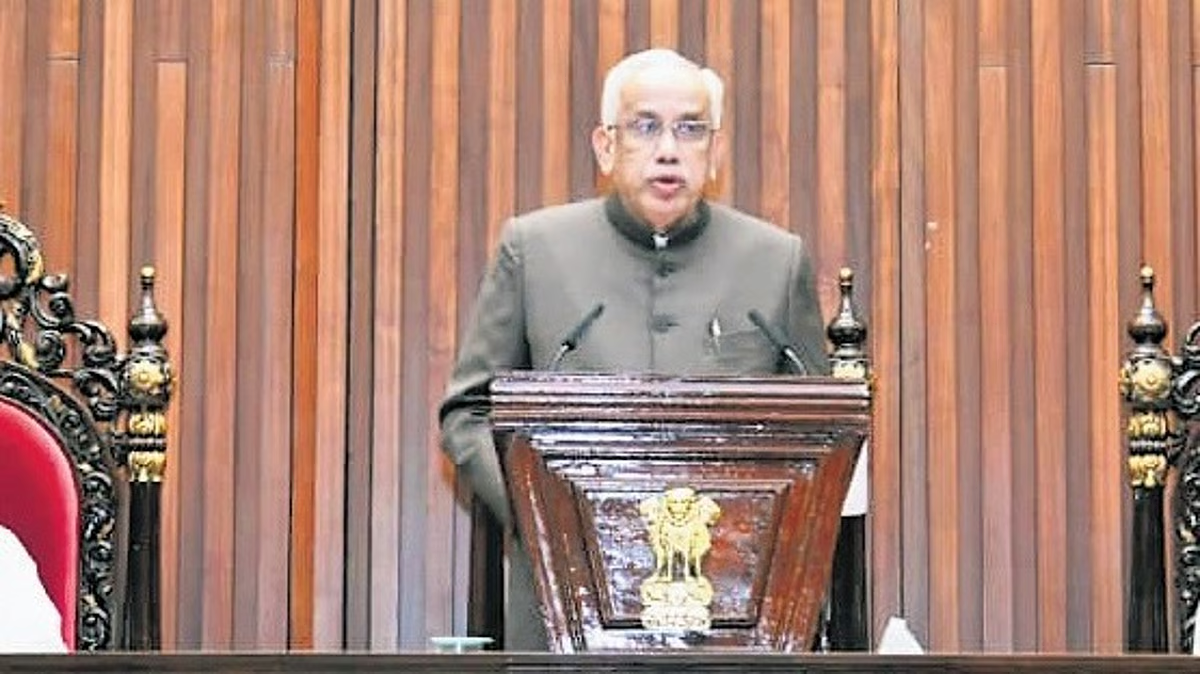
Deep Reflections on Constitutional Law, Judicial Independence, Democracy, and the Intersection of Law and Governance
Understanding the dynamic nature of constitutional law in a vibrant democracy

The Constitution of India is often described as a living document — but what does this metaphor truly mean, and what are its implications for how we understand and apply constitutional law?
At its core, the concept of a living Constitution reflects the recognition that a document drafted in the mid-twentieth century must be capable of addressing challenges that its framers could not have anticipated. The Constitution's genius lies not in its prescience about specific future events but in the flexibility of its core principles — justice, liberty, equality, and fraternity — which can be applied to new circumstances without betraying the document's fundamental commitments.
The challenge of constitutional interpretation in the Indian context is particularly demanding because of the document's unusual breadth and ambition. Unlike constitutions that confine themselves to structural arrangements and a limited bill of rights, the Indian Constitution contains Directive Principles of State Policy, Fundamental Duties, provisions for social and economic justice, and elaborate provisions for the protection of minorities, Scheduled Castes, and Scheduled Tribes. This comprehensive scope means that constitutional interpretation must grapple with a wider range of values and interests than in most other democratic systems.
The development of constitutional jurisprudence in India has been marked by several important evolutionary phases. In the early decades after independence, the courts grappled with the relationship between fundamental rights and directive principles, gradually developing a jurisprudence that sought to harmonize these seemingly competing constitutional commands. The celebrated basic structure doctrine, established in the Kesavananda Bharati case, represented a watershed moment — the Court's assertion that certain features of the Constitution are so fundamental that they cannot be altered even by the formal amendment process.
In more recent decades, the expansion of Article 21's scope — from a narrow prohibition on arbitrary deprivation of life and liberty to a comprehensive guarantee of human dignity encompassing the rights to health, education, privacy, and a clean environment — has demonstrated the Constitution's capacity for organic growth. This expansion, driven by judicial interpretation that is simultaneously creative and constitutionally grounded, validates the living Constitution metaphor while also raising important questions about the proper limits of judicial interpretation.
The key insight, drawn from decades of judicial experience, is that constitutional evolution must be guided by constitutional principle. The Constitution can and must grow, but its growth must be organic rather than radical — rooted in the document's text and structure, informed by its history and purpose, and constrained by the principle of constitutional morality. Judges must be gardeners, not architects — nurturing the Constitution's growth rather than redesigning its structure.
The Constitution is not a rigid formula frozen in the moment of its adoption. It is a dynamic compact between a people and their aspirations — a compact that must evolve to remain relevant, but must never lose sight of the fundamental values that gave it birth.

Why judicial independence is not a privilege of judges but a fundamental right of the people
Judicial independence is perhaps the most essential structural feature of a constitutional democracy. Without an independent judiciary, the Constitution becomes a mere piece of paper — its guarantees of fundamental rights, its limitations on state power, and its provisions for the rule of law become unenforceable promises rather than binding obligations. An independent judiciary is the mechanism by which constitutional words acquire legal force.
But judicial independence is not an end in itself — it is a means to achieve justice. The purpose of insulating the judiciary from external pressures is to ensure that judicial decisions are made on the basis of law and evidence alone, free from the influence of political power, popular sentiment, media pressure, or any other extraneous consideration. This independence must be structural — secured through constitutional provisions governing appointment, tenure, and removal — and attitudinal — maintained through a judicial culture that values impartiality, integrity, and constitutional commitment above all else.
The Indian Constitution's framers understood this imperative and designed a system that provides significant protections for judicial independence: security of tenure, fixed compensation, a collegium system for appointments, and immunity from executive interference in judicial functions. These protections must be zealously guarded, not because judges are infallible, but because the alternative — a judiciary that can be manipulated by political power — is fundamentally incompatible with constitutional democracy.
However, judicial independence must be understood as carrying reciprocal obligations. An independent judiciary must be a responsible judiciary — one that exercises its enormous powers with restraint, transparency, and accountability. The legitimacy of judicial independence rests ultimately on the quality of justice that the judiciary delivers. If the judiciary fails to maintain the highest standards of integrity, competence, and impartiality, its claim to independence is weakened, regardless of the constitutional protections that nominally secure it.
The real test of judicial independence is not whether courts can withstand pressure from the powerful — though that is essential — but whether the judiciary inspires sufficient public confidence that its decisions are accepted as authoritative and legitimate, even by those who disagree with particular outcomes. This confidence is built not through institutional assertion but through the consistent demonstration of principled, well-reasoned, and fair adjudication.
Constitutional provisions that secure the judiciary's institutional autonomy — covering appointment, tenure, compensation, and protection from executive interference — form the foundation of judicial independence.
Beyond structural protections, judicial independence requires a mindset — an intellectual commitment to deciding cases on their merits, free from ideology, prejudice, or external influence, guided solely by the Constitution and the law.
The ultimate guarantor of judicial independence is public trust — built through consistent excellence in judicial performance, transparency in institutional governance, and accountability in the exercise of judicial power.
Exploring how constitutional principles shape governance practice and how governance challenges test constitutional theory
The relationship between law and governance is one of the most fundamental and consequential in any constitutional democracy. Law provides the framework within which governance operates; governance tests the adequacy of that framework against real-world challenges.
This intersection is particularly fascinating in the Indian context, where the Constitution simultaneously empowers the state to pursue ambitious social and economic transformation and constrains it through fundamental rights and the rule of law. The tension between these functions — empowering and constraining — is not a defect in the constitutional design but its essential feature. Democratic governance must be powerful enough to address the needs of a complex, diverse, and developing society, yet disciplined enough to respect the rights of individuals and the autonomy of communities.
The Governor's office sits at this intersection in a unique way. Unlike purely executive officials, who are primarily concerned with the efficient administration of government, the Governor — as a constitutional head — must constantly evaluate governance through the lens of constitutional validity. This dual perspective creates opportunities for governance that is both effective and constitutionally sound, but it also imposes obligations of constitutional fidelity that go beyond what is expected of ordinary administrators.
The governance challenges facing contemporary India — from economic development and poverty reduction to environmental protection and communal harmony — are ultimately constitutional challenges. Each requires the state to exercise its powers within the framework established by the Constitution, balancing competing interests, respecting fundamental rights, and adhering to the rule of law. The quality of governance, therefore, is inseparable from the quality of constitutional compliance.
This insight has profound practical implications. It means that good governance is not merely efficient administration — it is administration that is constitutionally conscious, rights-respecting, and rule-of-law-compliant. It means that policy formulation must include constitutional analysis alongside economic and social analysis. And it means that the evaluation of governance outcomes must include an assessment of their constitutional propriety alongside their practical effectiveness.
Why strong, independent institutions are the sine qua non of a functioning constitutional democracy
Constitutional democracy does not sustain itself automatically — it requires institutions that are strong enough to enforce constitutional norms, independent enough to resist political pressure, and competent enough to perform their assigned functions effectively. The judiciary, the Election Commission, the Comptroller and Auditor General, the Public Service Commissions — these and other constitutional bodies form the institutional infrastructure of Indian democracy. Their independence and effectiveness are not institutional privileges but constitutional necessities.
The doctrine of separation of powers — dividing governmental authority among the legislature, executive, and judiciary — is a foundational principle of constitutional governance. This separation is not merely structural; it is a guarantee of liberty, ensuring that no single entity accumulates enough power to threaten the freedom of citizens. The effective functioning of this separation requires that each branch of government exercises restraint and respect for the constitutional boundaries of the others.
The system of checks and balances ensures that governmental power is exercised responsibly and in accordance with constitutional principles. Judicial review, legislative oversight, executive accountability to the legislature — these mechanisms prevent the concentration of power and ensure that government operates within the boundaries established by the Constitution. Maintaining these checks requires constant vigilance and institutional commitment.
Strong institutions alone are insufficient — a healthy democracy requires an informed and engaged citizenry. Constitutional democracy demands not only the rule of law imposed from above but also democratic participation from below. Legal literacy, civic engagement, and constitutional awareness are essential for the vitality of India's democratic framework. Every citizen must understand their constitutional rights and exercise their democratic responsibilities.
Democracy is not a spectator sport — it demands the active, informed, and constitutionally conscious participation of every citizen. The strength of democratic institutions ultimately rests not on the authority they wield but on the trust and engagement of the people they serve.
Selected thought leadership on the most pressing issues facing India's constitutional democracy
An analysis of how Centre-State relations can be strengthened through constitutional dialogue, institutional cooperation, and a shared commitment to the federal principles embedded in the Constitution.
Exploring the unique conception of secularism in the Indian constitutional framework — its historical origins, judicial interpretation, and contemporary challenges in maintaining the delicate balance between religious freedom and state neutrality.
Why constitutional governance requires more than mere legal compliance — it demands a deep commitment to the values and principles that animate the Constitution, informing every aspect of public administration and policy-making.
Connect with the office of Governor Syed Abdul Nazeer for inquiries, collaborations, and official communications.
Contact Us